

Understanding Chronic Venous Disease
Chronic Venous Disease (CVD) is a common vascular disorder where there is high pressure buildup in the veins. Normally, healthy leg veins contain valves that open and close to assist the return of blood to the heart. When the valves become damaged or diseased, they can no longer close properly due to inadequate muscle pump function or incompetent valves causing venous reflux.1

Chronic Venous Insufficiency
CVD can become a serious health issue if the disease
continues to progress.2 Varicose veins can be early
manifestations of Chronic Venous Insufficiency (CVI)
which is usually reserved for more advanced stages of
CVI.4
Perforating Veins
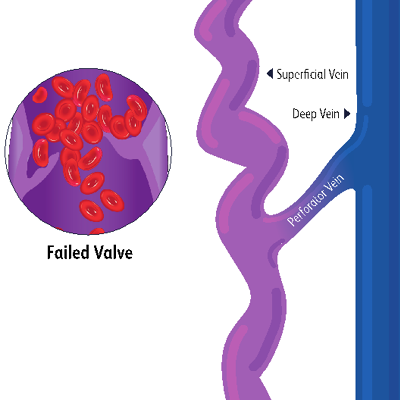
Perforator veins run through the muscular fascia as they connect the deep and superficial venous system, allowing passage of blood in between them. When abnormal blood flow, or venous reflux, is present in association to a non-healing venous ulcer, then treatment to close the perforating vein is recommended.5 Perforator vein insufficiency can additionally result in leg pain, skin changes, and venous ulcers.
How Venous Ulcers Form
Presence of an active or healed ulcer is a potential
indicator of incompetent perforator veins.1 The Society
for Vascular Surgery/American Venous Forum (SVS/
AVF) clinical practice guidelines for care of patients
with chronic venous ulcer currently define a pathologic
perforator as having a “diameter of >3.5 mm and >500
milliseconds of retrograde flow”5
These guidelines recommend ablation of pathologic
perforator veins when located beneath or associated
with potential ulcer beds in lipodermatosclerosis (C4b),
healed ulcers (C5), or active ulcers (C6)5

Chronic Venous Insufficiency
CVD can become a serious health issue if the disease
continues to progress.2 Varicose veins can be early
manifestations of Chronic Venous Insufficiency (CVI)
which is usually reserved for more advanced stages of
CVI.4
The main function of valves in the veins, is to keep blood moving back to the heart. These valves only allow upward and forward flow of blood. They also close in order to prevent blood from form going backwards down the leg.
With CVD, individuals may experience increased venous pressure, enlargement of the leg veins that leads to the leg veins becoming weak over time and resulting into venous reflux. This can occur for a number of reasons including improper valve function, dysfunction of calf muscle pump or even venous obstruction. This imbalance of blood flow causes a pressure increase and venous reflux resulting in leg pain, heaviness, swelling or venous ulcers.2,3 For some these symptoms can display as tortuous, visible bulges on the surface of the skin, otherwise commonly known as varicose veins.1
Perforator Veins
Perforator veins connect the deep and superficial venous system, allowing passage of blood in between them.
It’s important to find a trained vein specialist who can identify if a perforator vein is causing the underlying symptoms of a venous ulcer and additionally if venous reflux is present.5 For those who have both a perforating vein with venous reflux, then treatment to close the perforating vein may be recommended.5
Some vein specialists are trained to treat perforating veins, which could be causing underlying symptoms of a venous ulcer.

What is Advanced CVD?

When left untreated, signs and symptoms may worsen. CVD can progress and develop into a more serious form of venous disease called chronic venous insufficiency (CVI). This includes leg swelling, skin changes, and, in severe cases, venous ulceration.1
Prevalence & Stats
CVD represents a significant burden for people and many times this disease is misdiagnosed. Today, an estimated 175 million individuals are affected by CVD in the U.S. Of those, 50 million have varicose veins and another 50 million have more advanced venous disease symptoms.8
While risk of CVD increases with age, it can begin as early as adolescence.9 It’s important to know that what you’re experiencing may be more than just a cosmetic issue and not part of the normal aging process.8,10
Did you know that 70-90% of all lower leg ulcers are likely to be venous related?17,5 In the U.S., there are an estimated 4.8 million people who suffer from venous ulcers.8

Did you know that 70-90% of all lower leg ulcers are likely to be venous related?17,5 In the U.S., there are an estimated 4.8 million people who suffer from venous ulcers.8